San Diego’s infrastructure funding gap surges to $6.5 billion as growing needs outpace money

The City of San Diego faces significant infrastructure challenges, with a projected funding shortfall of $6.51 billion over the next five years. This gap has widened by 35% from the previous year's estimate of $4.81 billion.

Infrastructure Needs
San Diego's infrastructure encompasses a wide range of assets, including roads, buildings, utility systems, and public facilities. Each city department responsible for these assets maintains a list of necessary projects, which may involve constructing new facilities, purchasing equipment, major renovations, land acquisition, or roadway improvements.
Funding Requirements and Sources
The city's Capital Improvements Program (CIP) outlines the long-term plan for infrastructure projects and their funding. However, the demand for infrastructure improvements often surpasses available funding.
To finance these projects, San Diego employs several strategies:
-
Bond Financing: The city utilizes long-term borrowing through bonds to address cash flow needs and fund capital projects. This approach has been used to finance deferred capital projects, including enhancements to streets, buildings, and storm drains. citeturn0search1
-
Community Input and Planning: Engaging with residents, the city gathers community input to shape its infrastructure priorities. For instance, over 1,200 community-submitted ideas were considered for the Fiscal Year 2025-2029 Capital Infrastructure Planning Outlook. citeturn0search5
-
State and Federal Funding: The city seeks grants and allocations from state and federal sources to supplement local funding.
Despite these efforts, certain sectors face acute funding deficits. For example, the stormwater infrastructure has a $1.6 billion budget shortfall, leading to persistent pollution issues and recent flooding events that resulted in the loss of hundreds of homes in January 2024. citeturn0search9
Addressing San Diego's infrastructure needs requires a multifaceted approach, combining local initiatives, community engagement, and external funding to bridge the substantial financial gaps.
San Diego’s infrastructure funding gap surges to $6.5 billion as growing needs outpace money – San Diego Union-Tribune
San Diego’s funding shortfall for infrastructure projects ballooned to a record $6.51 billion this winter, just three months after city voters rejected a sales tax increase that could have helped close the gap.
The shortfall — the gap between projected infrastructure needs over the next five years and the funding available for them — surged 35% from the $4.81 billion shortfall estimated last winter.
And the gap has more than tripled since early 2020, when city officials estimated it at $2.16 billion.
“The outlook is getting a little more scary each year,” said Councilmember Marni von Wilpert when the new analysis was presented last week to the council’s infrastructure committee.
City officials say the gap is widening because of rising construction costs, higher borrowing costs and stricter regulations for how bridges, buildings, storm drains and other projects must be constructed and maintained.
But another key driver in San Diego’s case is that much of the city’s infrastructure has outlasted its lifespan because it was built during the population boom of the 1950s, 1960s and 1970s.
The gap could be even wider, but officials didn’t include the costs of new seawalls and other projects San Diego is expected to need as climate change accelerates sea level rise.
The 80-page analysis also excludes any projects that would be constructed after 2030 from the estimated funding gap, partly because it’s difficult to forecast available funding that far out.
But the analysis does include a cost estimate of $8.9 billion for projects the city is likely to need after 2030. That’s up from $6.5 billion last winter, the first time city officials had attempted such an estimate.
The $6.51 billion gap is the difference between the $11.87 billion in needed projects over the next five years and the estimated $5.36 billion the city will have to pay for them.
The money comes from developer fees, state gas tax money and two dozen other sources.
The gap looks more severe when water and sewer projects are eliminated from the estimated infrastructure gap. Those projects are different because city officials can eliminate any funding gaps by raising customer rates.
When the focus is narrowed to just general fund projects, the city has $7.94 billion in infrastructure needs over the next five years and only $1.43 billion to cover them. That means the city has less than 20% of the money it needs.
The largest gap by far is for stormwater projects, which include upgrading drains, clearing flood control channels and other projects focused on water quality and flood prevention.
Stormwater needs over the next five years are estimated at $4.13 billion, but city officials say they expect to have only $394 million to fund them — leaving a gap of $3.74 billion.
The City Council last year debated a possible November ballot measure that would have increased San Diego’s outdated city storm water fees with a parcel tax.
But they decided instead to focus on a one-cent sales tax increase. While the $400 million in annual revenue from that tax could have been spent on anything, officials vowed to spend much of it on stormwater projects.
Voters narrowly rejected the sales tax measure, leaving city officials to decide whether to try again in 2026 or 2028 and whether a separate stormwater fee increase should also be pursued.
The analysis paints a grim picture of the stormwater system.
“The city’s stormwater infrastructure is largely past its useful life, resulting in system deterioration and failure,” it says. “Age, combined with deferred maintenance due to historical underfunding of the storm drain system, poses a risk of flooding and catastrophic failure.”
The analysis also notes that nearly all of the city’s rivers and streams are considered impaired under the federal Clean Water Act.
But there are large shortfalls in other areas, too, including gaps of $1.72 billion for roads and other transportation projects, $298 million for buildings, $250 million for fire stations, $244 million for parks, $99 million for police facilities, $61 million for lifeguard stations, $42 million for shelters and $38 million for library projects.
The analysis provides detailed descriptions for most of the projected funding gaps.
For police, the main drivers are the need for a new firing range, a new traffic division building, a new headquarters for the northern division and significant renovations to the former Chargers training facility.
The northern division headquarters dates back to 1968 and features walls of concrete and metal that complicate the use of wifi. The traffic division operates in a group of trailers that were all built more than 25 years ago.
“They certainly need some love and attention to some of their facilities,” von Wilpert said of the Police Department.
Some good news is that city officials say previous estimates of the infrastructure funding gap have underestimated how much grant funding the city typically receives for projects.
For example, the 2020 version of the report estimated San Diego would secure $30.4 million in grants over the next five years. The actual amount ended up being over $200 million.
But some bad news is that most of the city’s comprehensive assessments of sidewalks, buildings and other infrastructure were completed nearly a decade ago. The analysis says that means the funding needs are likely significantly larger.
Another piece of bad news: a city audit last fall that found officials have been underestimating the infrastructure shortfall by roughly $1 billion by ignoring and postponing hundreds of minor maintenance projects.
Councilmember Kent Lee said the city is making things worse by not dealing with problems quickly, which allows them to worsen and become more expensive. “The cost of not acting sooner tends to increase significantly,” he said.
Von Wilpert suggested the city explore alternative funding methods, such as naming rights. “At this point, we need all the dollars we can get,” she said.
San Diego is the only city in the region that has assessed all its infrastructure in the last few years, and the only city to estimate its infrastructure funding gap every winter — a practice that began 10 years ago.
While the funding gap is daunting, city officials say they’d rather know where they stand than remain in the dark and kick the can down the road to future city leaders. Officials say that’s what happened for decades, creating the problem the city faces now.
The city’s independent budget analyst told the infrastructure committee that the only solution is new revenue streams. The IBA also said rebuilding in the wake of the Los Angeles fires is likely to elevate construction costs more than estimated.
The IBA is scheduled to release a full report on the new analysis Feb. 27, a few days before the analysis is slated for City Council discussion on March 3.
Originally Published:
Emergency repair costs to city of San Diego infrastructure soared 84% since 2022
With a budget deficit of more than $258 million, the city of San Diego is pinching every penny it has. In his State of the City address last month, Mayor Todd Gloria didn’t mince words.
"The task ahead ... is to right-size our city budget," Gloria said. "Not just for this year, but for the long-term. It is my expectation that we handle this structural deficit this year. No gimmicks, no Hail Mary passes.”
What hasn’t helped the city’s coffers: spending on emergency projects to repair crumbling infrastructure. Last week, the Active Transportation & Infrastructure Committee ratified the contracts on 29 of those projects, to the tune of $52,208,454.
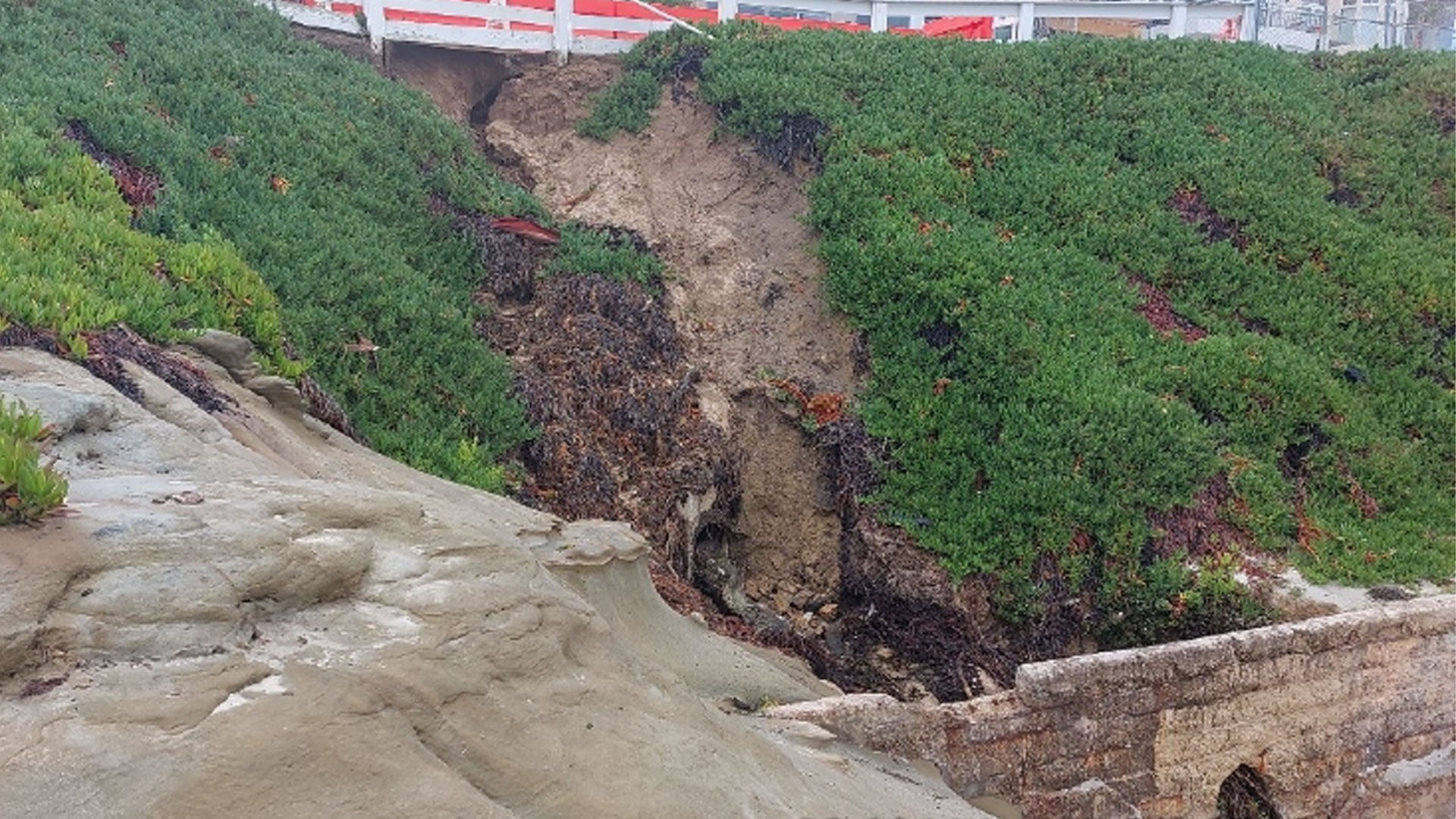
La Jolla storm drain repair
1 of 2
The list includes fixing collapsed storm drains, eroded roads and broken braces on the Crystal Pier. The city also paid nearly $3 million to clean out and repair clogged stormwater channels after the disastrous flooding in January 2024.
Unlike most infrastructure projects, which go through lengthy planning stages, emergency projects are rubber-stamped without a competitive bidding process. One council member conceded those pricier contracts aren’t ideal.


“Of course, none of us love emergency projects,” Marni von Wilpert said. “In an ideal world, we get to vet them out, get the lowest bid, but when things collapse, we have to fix them.”
NBC 7 Investigates pulled emergency repair records for the last three fiscal years. The city spent 84% more on emergency repair contracts in Fiscal Year 2024 than in FY2022.
The increasing repairs have become so common that city staff is now planning for them, setting aside money to cover pricey Band-Aids when critical infrastructure inevitably buckles.
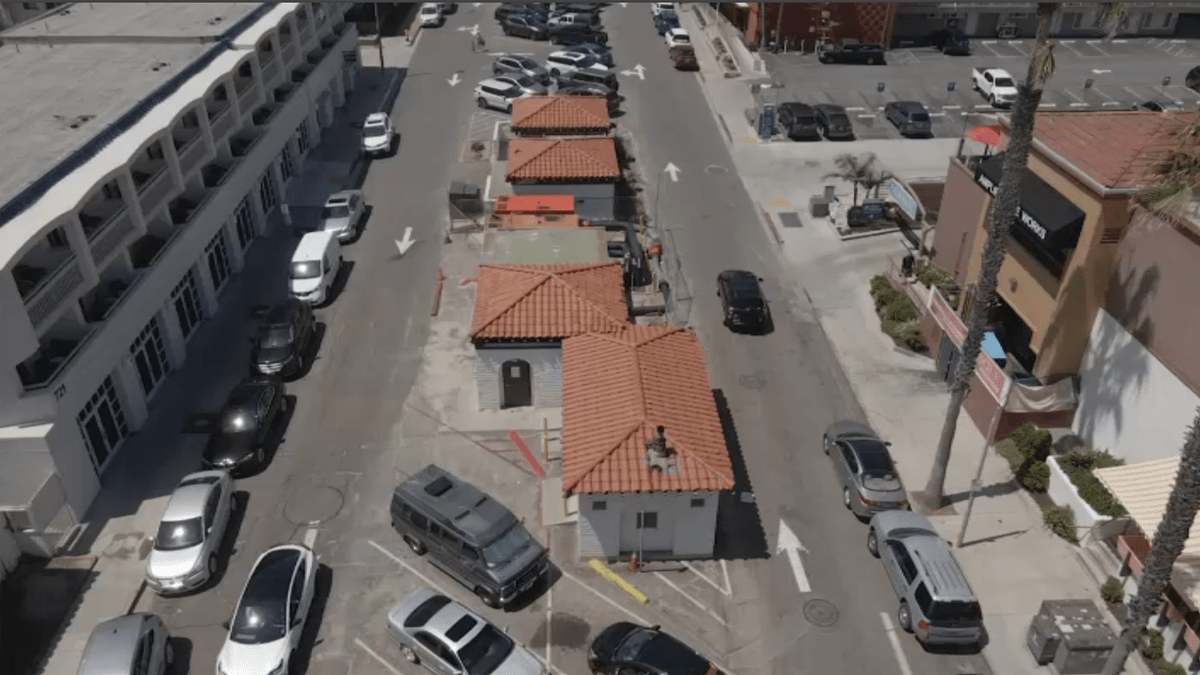
NBC 7 got a firsthand look at one of those Band-Aids in September 2023 at one of the city’s stormwater pump stations in Pacific Beach; two big orange boxes installed by a private contractor when the actual pump station didn’t work. At that time, the price tag was $22,000 a month.
Stormwater Pump Station G
1 of 7
Those private pumps were among the $28 million spent on emergency repairs throughout the city that fiscal year. It was money the stormwater director said his department couldn’t afford to spare.
“There's a big deficit between what the funding looks like today and what we need,” Todd Snyder told NBC 7 in 2023. “Last year alone, there were 20 emergencies relating to flooding due to failing storm drain systems … public dollars taken away from other city programs to fund stormwater repairs.”
NBC 7 reached out to three council members for an interview for this report. All three declined our requests.


Comments
Post a Comment