San Diego City’s Plan for Homeless is not Adequate and May be Rapidly Overwhelmed
What We Know About the City’s H Barracks Plan | Voice of San Diego
SAN DIEGO (FOX 5/KUSI) — A permit application filed by the City of San Diego with the California Coastal Commission shows that part of the H Barracks in Point Loma could also include a potential shelter. The application is set to be acted upon this Wednesday.
Lashay Roberts, currently living in a van, said, “It’s been difficult because we don’t have a routine – a stable spot to stay at.” Her red van is as stable for she and her partner Aiden Casper along with their four-legged friend.
“We’re both trying to look for jobs at the same time,” Roberts said.
It’s a long road with little resources, making it tough to find solid ground.
“We’re hopping around, going from a 24-hour open place to this one that is not,” Roberts said.
A proposed safe sleeping site at the H Barracks lot on Harbor Drive, equipped with restrooms, showers, and mental health services, could change that.
The site would mainly serve people experiencing homelessness for the first time, helping them get back on their feet.
“Being able to have a shower, some food, a safer spot,” Robert said.
But now there’s growing contention over what else is part of the H Barracks plan.
A permit submitted in April with the Coastal Commission shows a second phase including a potential temporary 600-bed shelter. It will be voted on this Wednesday after hearing from the public.
Falconer, the director of Point Loma Cares, says the shelter wasn’t addressed when the mayor talked about plans for H Barracks in June.
“It just gives us more anxiety as to what exactly are the intentions behind what’s going on here and what may or may not trigger building this phase two,” he said. “We’re 250 yards away from Terminal 2 at the airport, we’re across the street from a children’s playground.”
In a statement, the city says it is focused exclusively on hosting a safe parking program at the H Barracks site. It says there are no plans to move forward with sprung structures but included them in the application to preserve the option should it be needed.
For this couple living in their van for a second year in a row, all they hope for is change.
“I was a professional. My circumstances worked out to where I ended up having to move out. You never know what’s going to happen to you,” Roberts said.
The California Coastal Commission will act on the city’s application this Wednesday. If you’d like to sign up to speak, visit this link on the California Coastal Commission website.
San Diego's plan to bring safe parking site for homeless to H Barracks moves forward
The California Coastal Commission on Wednesday unanimously approved a city of San Diego permit application to create nearly 200 parking spaces for people experiencing homelessness at the H Barracks site in Point Loma.
"This is a crucial step towards providing more safe places for people living in their vehicles to go and access services to help end their homelessness," San Diego Mayor Todd Gloria said in an X post after the Coastal Commission approved the plan.
The lot is across the street from Spanish Landing Park and served as a training facility for the San Diego Fire-Rescue Department. It got its name from H-shaped buildings that have since been torn down to make way for the city’s Pure Water Recycling project. That project is expected to take over the spot in five years, so, in the meantime, the city wants to use the lot to expand its Safe Parking Program.
According to the permit application, the site would have 190 parking spaces of varying sizes for standard vehicles, RVs and drivers who need accessible stalls. The plans also include a motorized entry gate, fencing with privacy screening, a pet relief area and cell phone charging stations among other things.
Relevant content:


The application outlines plans, referred to as phase two, for two 41-ft. tall, 18,000 sq. ft. tents that could be homeless shelters that would fit 300 people each. The addition came as a surprise to those who have been following the project.
Derek Falconer, the director of Point Loma Cares, said it was the community’s understanding the site would only be used for safe parking.
"It raises serious questions about accountability and transparency with an administration that hasn't had a great reputation engaging constituents and really getting stakeholder buy-in," Falconer said.
NBC 7 reached out to Gloria’s office to clarify what they intend to do at H Barracks. A spokesperson confirmed the city’s focus is exclusively on using it for their Safe Parking Program. They added they wanted to seek approval for the tents at the same time so that they have it as an option, but it is not the intention as of now.
"Safe parking I think can work here. I think the right parameters around that with the right electrical hookups and wastewater and environment concerns, I think there’s a way to make that work," Falconer said.
The staff who reviewed the application for the commission shared similar concerns and suggested they approve the permit application, but with conditions. Those conditions included requiring the city to install “an engineered stormwater filtration device at the existing stormwater conveyance system.” That would help ensure any heavy metals, petroleum, etc. would not drain into the nearby water. Another condition “requires the City to implement best management practices to prevent accidental paint spills from entering nearby storm drains that flow directly into the San Diego Bay.”
The city did not respond to NBC 7’s request for an updated timeline on the project.
Summary of Likely Impact of Grants Pass Decision
Here's a summary of the current state of homelessness in San Diego and potential impacts of the Supreme Court's Grants Pass decision:
Current state of homelessness in San Diego:
1. The homeless population is growing, with 10,605 people experiencing homelessness in San Diego County as of January 2024, a 3% increase from the previous year.
2. The unsheltered population saw a significant 18% increase, with 6,110 people living on the streets or in vehicles - the highest number in recent history.
3. San Diego city has about 1,780 shelter beds, but the system remains over 90% full. On average, more than 1,000 requests for shelter are denied every month due to lack of space or inability to meet specific needs.
4. The city has implemented a controversial camping ban, making it illegal to camp citywide if shelter beds are available, and anytime near schools, parks, transit hubs, and waterways regardless of shelter availability.
5. Mayor Todd Gloria has proposed opening a new 1,000-bed shelter to address the crisis, though the plan has faced some obstacles.
Potential impacts of the Supreme Court's Grants Pass decision:
1. The ruling allows governments to enforce camping bans on public property even when there is no shelter available, without violating the Eighth Amendment's prohibition on cruel and unusual punishment.
2. For San Diego city, the immediate impact may be limited, as officials view the ruling as validation of their existing camping ban and enforcement approach. The city plans to continue its current strategy of offering shelter before enforcement.
3. However, the ruling could have a greater impact in other parts of San Diego County:
- Cities like Escondido and Poway, which have camping bans but limited shelter options, may feel empowered to increase enforcement.
- San Diego County is developing a camping ban for unincorporated areas, and the ruling could influence its implementation and enforcement.
4. Some local leaders see the ruling as an opportunity to more aggressively address homelessness and clear encampments, while others express disappointment and concern about potential criminalization of homelessness.
5. Homeless advocates and some legal experts warn that the ruling could lead to more punitive approaches that may exacerbate the homelessness crisis rather than solve it.
6. The decision may shift the focus of legal challenges to homelessness policies away from Eighth Amendment arguments to other constitutional grounds.
Overall, while the Grants Pass decision gives local governments more leeway in enforcing anti-camping laws, its full impact in San Diego will likely depend on how city and county officials choose to interpret and apply the ruling in their homelessness strategies.
Quo Vadis City of San Diego
The future of San Diego's homeless housing plan is likely to involve several key elements and face some challenges:
1. Expansion of shelter capacity:
- Mayor Todd Gloria has proposed opening a new 1,000-bed shelter, potentially in a converted warehouse. This is a significant part of the city's strategy to increase shelter options.
- The city is exploring various locations for new shelters, including the H Barracks site near Harbor Island, which could potentially accommodate up to 700 people.
2. Diverse housing options:
- The city's Comprehensive Shelter Strategy outlines short-, medium-, and long-term solutions, including leased warehouses, religious facilities, safe parking programs, and potential use of hotels.
- There are plans to expand safe sleeping sites and safe parking programs at multiple locations.
3. Continued enforcement of camping bans:
- With the Supreme Court's Grants Pass decision, the city feels validated in its approach to enforcing camping bans. This enforcement is likely to continue, possibly with increased vigor.
- The strategy involves offering shelter before enforcement, following a progressive enforcement model.
4. Focus on services and support:
- Plans include providing wrap-around services at shelter sites, including mental health resources, substance abuse counseling, case management, and housing navigation.
5. Potential challenges:
- Community opposition: As seen with the H Barracks proposal, there's likely to be continued resistance from some communities to new shelter locations.
- Funding constraints: The plan requires significant funding, and there's a gap between proposed initiatives and current budget allocations.
- Capacity issues: Despite plans for expansion, demand for shelter continues to outpace supply.
- Legal considerations: While the Grants Pass decision gives more leeway for enforcement, the city still needs to navigate existing legal settlements and potential new challenges.
6. Regional approach:
- There may be increased coordination between the city and county, especially as the county develops its own camping ban for unincorporated areas.
7. Emphasis on permanent solutions:
- While focusing on immediate shelter needs, there's likely to be continued emphasis on pathways to permanent housing and addressing root causes of homelessness.
8. Adaptation to changing circumstances:
- The plan will likely need to evolve based on the effectiveness of current strategies, changing homeless population dynamics, and available resources.
9. Continued debate and policy adjustments:
- Given the complex nature of homelessness and differing opinions among policymakers and the public, ongoing debate and policy adjustments are likely.
Overall, San Diego's approach seems to be moving towards a multi-faceted strategy that combines increased shelter capacity, diverse housing options, enforcement of camping bans, and supportive services. However, the success of this plan will depend on overcoming significant challenges in funding, community acceptance, and effectively scaling up solutions to match the growing need.
Regional Homelessness
The critical challenge in addressing homelessness at a city level is that it is a regional level problem. If other cities in San Diego County implement more restrictive policies or increase enforcement without providing adequate alternatives, it could potentially lead to a concentration of homeless individuals in the City of San Diego. This scenario could indeed overwhelm the city's resources and existing plans. Let's break this down:
1. Potential for displacement:
- The Supreme Court's Grants Pass decision may embolden some cities to enforce anti-camping laws more aggressively.
- Cities like Escondido and Poway, which have camping bans but limited shelter options, might increase enforcement without necessarily expanding services.
2. San Diego as a hub:
- As the largest city in the county with the most services, San Diego could become a default destination for individuals displaced from other areas.
- This could exacerbate the existing strain on San Diego's homeless services and housing programs.
3. Current inadequacies:
- Even San Diego's current plans appear inadequate and underfunded. The information available shows:
- A gap between proposed initiatives and budget allocations
- Shelter demand consistently outpacing supply (1,000+ shelter requests denied monthly)
- A growing unsheltered population despite existing efforts
4. Regional imbalance:
- If smaller cities in the county adopt more restrictive policies without providing alternatives, it could create a regional imbalance in addressing homelessness.
- This could potentially undermine San Diego's efforts by increasing the influx of homeless individuals beyond what the city has planned for.
5. Funding and resource challenges:
- The city is already struggling to fully fund its homeless initiatives.
- An influx of additional homeless individuals from other parts of the county could further strain these limited resources.
6. Need for regional coordination:
- This situation underscores the importance of a coordinated, county-wide approach to addressing homelessness.
- Without such coordination, there's a risk of creating a "race to the bottom" where cities compete to have the most restrictive policies, ultimately concentrating the issue in San Diego.
7. Potential for increased visibility of homelessness:
- If San Diego becomes overwhelmed, it could lead to more visible homelessness in the city, potentially increasing public pressure for solutions.
8. Legal and humanitarian concerns:
- While the Grants Pass decision gives more leeway for enforcement, pushing homeless individuals from city to city without adequate alternatives raises both legal and ethical concerns.
The current situation highlights the complex interconnectedness of homelessness policies across a region. It suggests that for San Diego's plans to be truly effective, they may need to be part of a broader, well-coordinated county-wide strategy that ensures all cities are contributing to solutions rather than potentially shifting the burden. Without such coordination, there's a real risk that San Diego's efforts, even if expanded, could be undermined by becoming the "last resort" for individuals displaced from other parts of the county.
Summary of City of San Diego's comprehensive shelter strategy to address homelessness 6/8/2023
This document outlines the City of San Diego's comprehensive shelter strategy to address homelessness. Key points include:
1. Current shelter landscape: The city funds 1,784 shelter beds, accounting for 85% of the county's emergency shelter beds.
2. Shelter need: Based on 2022 data, there were 2,494 unsheltered individuals in San Diego. The city needs to relocate 930 existing shelter beds and add approximately 600 new beds/sleeping options.
3. Planned interventions:
- Short-term: Leased warehouses, religious facilities, Camp Barrett, Travelodge, Golden Hall expansion, etc.
- Medium-term: NTC H-Barracks, HomeKey Hotels
- Long-term: Old Central Library, Homelessness Response Center
4. Safe sleeping/camping options are being explored at various locations.
5. Safe parking program expansion is planned at multiple sites.
6. Outreach efforts: The city funds 52.5 FTE outreach workers and plans to expand the Family Reunification Program.
7. Equity focus: The strategy aims to address racial disparities in homelessness, particularly for Black San Diegans.
8. Budget: FY 2024 proposed budget includes $43.4 million in General Funds and $34.7 million in grant funding for homelessness programs.
9. The strategy aligns with best practices and various local, state, and federal plans to address homelessness.
The document emphasizes the city's commitment to expanding shelter capacity, providing diverse options for individuals experiencing homelessness, and addressing equity issues in its approach.
The Interventions, Capacities, and Budget
To calculate the total number of beds and funding required in the short term, I'll sum up the capacities and costs for the short-term interventions where specific numbers are provided:
Beds/Capacity:
- 1. Leased Warehouses: 50-300
- 2. Leased/Purchased religious facilities: 50-300
- 3. Camp Barrett: 168
- 4. Travelodge: 42 rooms
- 5. Golden Hall 2nd Floor: 120
- 6. 16th & Newton Expansion: 50 (increase)
- 7. 17th & Imperial Expansion: 12 (increase)
- 8. Non-Congregate DV Shelters: 80-120 (estimated)
- 9. Urban Street Angels Youth Shelter: 33 (increase)
- 10. LGBTQ+ Youth Shelter: 21
Total short-term bed increase: 626-1,166
Funding required:
- 1. Leased Warehouses: $1.4-$8.6M
- 2. Leased/Purchased religious facilities: $1.4-$8.6M
- 3. Camp Barrett: $2.4-$4.1M
- 4. Travelodge: $3.1-$4.2M
- 5. Golden Hall 2nd Floor: $2.2-$2.4M
- 6. 16th & Newton Expansion: $500K-$550K
- 7. 17th & Imperial Expansion: $100K-$120K
- 8. Non-Congregate DV Shelters: Funded by State and County (amount not specified)
- 9. Urban Street Angels Youth Shelter: $2.4M
- 10. LGBTQ+ Youth Shelter: $1.8M
Total short-term funding required: $15.3M - $32.75M (excluding the DV shelters funded by State and County)
It's important to note that these figures are estimates and may vary based on actual implementation. Additionally, some interventions have ranges for both capacity and cost, which accounts for the wide range in the totals.
NTC H Barracks
Current State:
The document doesn't provide detailed information about the current state of NTC H-Barracks. However, it's clear that the site requires significant work before it can be used for shelter purposes.
Plans:
1. Abatement and Demolition:
- Abatement is scheduled to begin in July 2023.
- The estimated timeline for abatement and demolition is 12-16 months.
2. Proposed Use:
- After abatement and demolition, the site is planned for potential mixed-use, including:
a) Sprung structures for shelter
b) Safe parking
c) Safe sleeping
3. Capacity:
- The plan includes multiple sprung structures.
- Total capacity across structures is estimated at 300-700 beds.
- The document notes that smaller sprung structures (120-160 beds each) are likely to yield better service engagement and shorter lengths of shelter stay before exit to permanent housing placements.
4. Timeline:
- The estimated completion date is Summer 2024.
5. Budget:
- The Engineering & Capital Projects department (E&CP) is developing rough estimates for demolition and construction costs.
- Operating costs will vary based on the final configuration of the site.
- The total estimated cost range is $7.7M-$20M.
6. Additional Considerations:
- The site might also be used for oversized vehicles in the safe parking program.
- There's mention of potentially using the site for tiny homes, though this isn't elaborated on in detail.
The document emphasizes that this is a medium-term option, suggesting that while it's not an immediate solution, it's a significant part of the city's strategy to expand shelter capacity in the near future.
Mayor Todd Gloria’s homeless shelter strategy is mostly unfunded. Here’s what it could cost
Why this matters
San Diegans are divided on how to address the homelessness crisis while the city moves forward with a new law to ban encampments in public spaces.
Mayor Todd Gloria sold the San Diego City Council on a controversial camping ban using a homeless shelter expansion strategy that mostly hasn’t been funded yet.
Councilmembers voted 5-4 Tuesday during the second and final public hearing to make it illegal to camp citywide if shelter beds are available, and anytime, regardless of shelter availability, near schools, parks, transit hubs and along waterways.
Some elected officials, housing experts and attorneys have questioned whether the city will have enough shelter to enforce the ban. Courts have ruled that cities cannot criminalize people for carrying out life-sustaining activities in public, such as sleeping or sheltering, when there is no other indoor option.
That’s why some councilmembers asked Gloria to provide a comprehensive plan to expand shelter capacity before voting on the proposed camping ban two weeks ago. In response, Gloria and his staff outlined more than 20 locations where people would be allowed to camp, sleep in a vehicle and obtain indoor shelter, adding at least 600 new options for unhoused San Diegans over the next 18 months.
All told, it would cost between $30 million and $66 million to pay for everything on Gloria’s list. But the city’s budget only has $7.4 million set aside to expand shelter next year, according to city staff.
Gloria’s plan also includes:
- Warehouses, vacant religious facilities and a former juvenile detention camp as options for shelter, potentially adding hundreds of additional beds. Those sites have not been funded yet.
- Six library parking lots for people living in a vehicle to sleep overnight, offering between 48 and 120 spaces each. Gloria’s spokesperson, Dave Rolland, said these sites are partially funded but did not provide details.
Some councilmembers, who opposed the camping ban, questioned the math and asked staff members how they plan to bridge the gap for money and necessary space.
Ultimately, the city will count on donations from private, corporate and philanthropic groups, said Sarah Jarman, the top city official dedicated to homelessness solutions.
The comprehensive strategy is an overview of potential options, Jarman added, and the total cost and capacity of each site is unknown because staff members still need to iron out the details of what each site could offer. The sites would also include the cost of security, bathrooms, meals and connections to service providers.
Some of the funded projects are paid for through existing contracts, Rolland said. The city would have to pursue additional money to pay for any new projects.
In the short term, officials are working to open two campsites in Balboa Park. The first, located at 20th and B streets, is slated to open Saturday, while the other, in “O lot,” will be ready this fall.
Councilmembers applauded the strategy, even those who ultimately opposed the ban, saying it’s a necessary step to address the growing crisis unfolding in neighborhoods across the city. But some expressed doubts about whether it would be enough to enforce a ban in most public places.
The city’s shelter system remains more than 90% full, despite capacity having increased to 1,780 beds under Gloria’s leadership. Meanwhile, at least 3,300 San Diegans are living on sidewalks, or in riverbeds and canyons — the highest number recorded in at least a decade.
On average, more than 1,000 requests for shelter are denied every month, said Lisa Jones, with the San Diego Housing Commission. It often happens because there isn’t enough space or a person’s needs cannot be met.
Officials hope providing a place to legally live in a tent — and offering services such as wellness checks, health screenings and shelter outreach — will move people out of dangerous and unhealthy encampments.
“I think it’s going to accommodate a majority of folks,” San Diego police Capt. Shawn Takeuchi told councilmembers. “And an individual who says no, for whatever reason they’re saying no, they’re choosing a reason, it’s not because the bed is not compatible.”
City staff and police officials have said all they need is one space available that can meet the needs of the person facing enforcement. But experts have said the city is taking a gamble that could cost taxpayers later in court.
A frequently cited federal court ruling from 2018, known as Martin v. Boise, establishes certain rights for people experiencing homelessness. The ruling said, “as long as there is no option of sleeping indoors, the government cannot criminalize indigent, homeless people for sleeping outdoors, on public property, on the false premise they had a choice in the matter.”
The federal court ruling does not define what a shelter is, beyond an indoor sleeping space that is practically accessible. But in a subsequent case stemming from the city of Chico, where officials tried to set up a sanctioned campsite on an unused airport tarmac, the judge ruled the campsite didn’t meet the definition of shelter.
inewsource asked the city attorney’s office about the case from Chico and whether officials think an open space at a sanctioned campsite would meet the definition of available shelter under the law.
“It is unclear from current case law what will satisfy a court as to ‘available shelter,’” a spokesperson from the city attorney’s office said. “Based on existing case law, our office recommends shelter provided by the city include protection from the elements and meet basic human needs for access to clean water, restrooms, food, safety, etc.”
The ban will take effect 30 days after the first city-sanctioned campsite opens at 20th and B streets in Balboa Park. That means police could start enforcing the new law at the end of July, focusing enforcement around schools, shelters, parks, transit hubs and along waterways.
When asked by a councilmember two weeks ago if the proposed ban would encourage more people to accept shelter and services, Gloria answered with a resounding “yes” and called out those who had voiced opposition.
“Between the combination of more opportunity (for places to go) coupled with more consequences for turning down services,” Gloria told councilmembers, “this will … bring more people into care and reduce the number of unsheltered individuals living on the streets in your district, Councilmember Montgomery Steppe, your district, Councilmember Lee, and your district, Councilmember Moreno.
“It’s your choice,” Gloria said.
Editor’s note: June 27, 2023
This story has been updated to include the San Diego City Council’s final vote on the encampment ban.
| Location | High Cap | Timing | Low Cost Million $ | High Cost Million $ | Status | Cum Spaces | Cum Req Fund | Cost/ Space, k$ |
| Aero Drive Expansion | 20 | Jun-23 | 0.06 | 0.06 | funded | 20 | 0.06 | 3.0 |
| Dreams for Change Expansion | 20 | Jun-23 | 0.10 | 0.12 | funded | 40 | 0.18 | 4.4 |
| Malcolm X Library | 120 | Jun-23 | 0.70 | 0.92 | partial | 160 | 1.10 | 6.8 |
| Travelodge | 42 | Jul-23 | 3.10 | 4.20 | funded | 202 | 5.30 | 26.2 |
| Golden Hall (2nd Floor) | 120 | Jul-23 | 2.20 | 2.40 | funded | 322 | 7.70 | 23.9 |
| “O” Lot* | 400 | Sep-23 | 7.30 | 11.00 | funded | 722 | 18.70 | 25.9 |
| Serra Mesa Library | 76 | Sep-23 | 0.44 | 0.58 | partial | 798 | 19.28 | 24.2 |
| Mira Mesa Library | 85 | Sep-23 | 0.50 | 0.65 | partial | 883 | 19.93 | 22.6 |
| Mission Valley Library | 75 | Sep-23 | 0.44 | 0.57 | partial | 958 | 20.50 | 21.4 |
| Pacific Beach Library | 48 | Sep-23 | 0.28 | 0.37 | partial | 1006 | 20.87 | 20.7 |
| Skyline Hills Library | 84 | Sep-23 | 0.49 | 0.64 | partial | 1090 | 21.51 | 19.7 |
| Warehouses | 300 | Mar-24 | 1.40 | 8.60 | 0 | 1390 | 30.11 | 21.7 |
| Vacant Religious Facilities | 300 | Mar-24 | 1.40 | 8.60 | 0 | 1690 | 38.71 | 22.9 |
| NTC H-Barracks | 700 | Jun-24 | 7.70 | 20.00 | partial | 2390 | 58.71 | 24.6 |
| 16th & Newton Expansion | 50 | Jul-24 | 0.50 | 0.55 | funded | 2440 | 59.26 | 24.3 |
| 17th & Imperial Expansion | 12 | Jul-24 | 0.10 | 0.12 | funded | 2452 | 59.38 | 24.2 |
| 20th & B | 136 | Jul-24 | 1.00 | 2.00 | funded | 2588 | 61.38 | 23.7 |
| Camp Barrett | 168 | Sep-24 | 2.40 | 4.10 | 0 | 2756 | 65.48 | 23.8 |
| Homekey Hotels | 300 | TBD- | tbd | tbd | tbd | 3056 | #VALUE! | #VALUE! |
| Old Central Library | TBD | TBD- | tbd | tbd | tbd | #VALUE! | #VALUE! | #VALUE! |
| Homelessness Response Center | TBD | TBD- | tbd | tbd | tbd | #VALUE! | #VALUE! | #VALUE! |
San Diego homelessness increases, driven by spike in unsheltered population

At least 10,605 people were experiencing homelessness in San Diego County during the region's annual January homeless census, according to data released today.
Why it matters: This year's 3% increase is down steeply from the 22% rise the region experienced in 2023, but the homeless population is still growing despite $2 billion having been spent on the crisis since 2015.
By the numbers: Of the unhoused people in the county during the count, 6,110 were unsheltered, with the remainder in some form of shelter service, per the report from the Regional Task Force on Homelessness (RTFH).
- That's up from 5,171 unsheltered people last year, or 18%.
- The unsheltered count is the largest in recent history, topping the 5,621 in 2017.
The intrigue: The county's sheltered homeless population was 4,495 — actually down 12% from last year.
- That decrease coincided with the loss of emergency federal funding for for hotel/motel vouchers, the RTFH report notes.
- The roughly 450 people living at two camping sites operated and considered safe by the city are also counted as part of the region's unsheltered population.
What they're saying: The number of people living in their cars increased by 44% — from 768 last year to 1,104 this year — leading task force CEO Tamera Kohler to conclude the region needs to focus on shelter options.
- "We must focus on populations like seniors, veterans and people living in cars, where proven housing strategies can make a difference in the months and years ahead," she said in a statement accompanying the report.
What we're watching: Mayor Todd Gloria pledged in his state of the city speech this year to open a new, 1,000-bed shelter to get people experiencing homelessness off the streets and connect them with services.
- That promise has become his attempt to lease a Middletown warehouse, but it has stalled after city and industry officials criticized the deal as too expensive.
What to Know About the City of San Diego's H Barracks Plan
In order to provide more shelter options and locations for expanding homeless shelter opportunities, the City of San Diego has identified H Barracks, near Harbor Island, as a potential site.
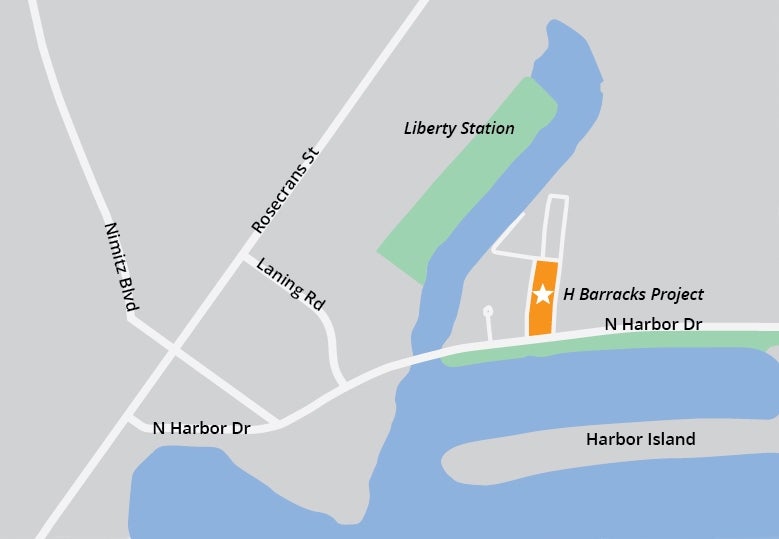
Earlier this year, the City released our Comprehensive Shelter Strategy, a plan outlining short-, medium- and long-term solutions to get San Diegans experiencing homelessness off the streets and into permanent housing.
The Shelter Strategy identifies several possible options for underused City-owned land and other public facilities that could be put to use to help address this crisis.
H Barracks is City-owned industrial land located off North Harbor Drive between Kincaid Road and McCain Road, sandwiched between the San Diego International Airport and an inlet of the North San Diego Bay. H Barracks is approximately a 25-minute walk from Liberty Station.
The site has served as a police and fire department training facility and was identified as one of those sites that could accommodate a shelter and services. The training facilities are set to be relocated, and in five years, the City plans for the site to host a Pure Water recycling facility. In the meantime, it can be put to work helping address homelessness.
City staff is gathering community and stakeholder input that will be used to develop plans for the site. What is certain is that it will have what all City facilities serving people experiencing homelessness have: 24-hour onsite security, privacy fencing, connections to transit and transportation, and connections to services that will help people end their homelessness, like mental health resources, substance abuse counseling, case management, housing navigation and medical care assistance.
The City is taking an all-hands-on-deck approach to addressing homelessness from every possible angle, and projects like H Barracks are critical to our efforts to get people off our streets and into safe shelter and housing.

Hundreds of Point Loma residents packed a town hall meeting in Liberty Station on Feb. 26 expressing their unwavering opposition to the proposed conversion of nearby City-owned H Barracks into a temporary, large-scale homelessness services shelter.
City plans are to build a homeless shelter with wrap-around services on the five-acre H Barracks site, on North Harbor Drive next to the end of the San Diego International Airport’s runway, accommodating up to 700 people on a referral-only basis.
The City contracts with various service providers to offer shelter options to people experiencing homelessness. At shelters, people are connected to support services and ultimately put on a path toward permanent housing.
Hosted by nonprofit Point Loma Cares, formerly Protect Point Loma, the town hall was kicked off with a video, https://youtu.be/pgvlPMBfxu8, created by Point Loma Cares followed by a slideshow presentation by Derek Falconer, the nonprofit’s director.
“It’s time to create some unity and protect our community in Point Loma,” said community activist Margaret Virissimo while introducing Falconer.
“I am excited to be around so many people who care about this community, about our children, and care about helping the homeless,” said Falconer noting the City passed an unsafe camping ban in June 2023 to move the homeless from streets to shelters necessitating creation of more new shelter space. “We are not here tonight to vilify homeless folks,” he said. “But, we need to have an adult conversation about some of the struggles – drugs, crime, mental health – that come with homelessness, and what it means to (potentially) add (up to) 1,000 more people in our community.”
Falconer pointed out that, across the street from H Barracks, are two hotels that he contended “are going to be seriously impacted” by a new homeless shelter. He also noted there are nine schools at Liberty Station educating over 3,000 children daily, who use playgrounds that would be near the new shelter.
“This size shelter puts children in the front lines of the homeless crisis,” concluded Falconer, who called upon Jaeden Hicks, a senior and ASB president at the Rock Academy at 2320 Truxtun Road, to give a student perspective on the issue.
“I’m here to speak for students who can’t speak for themselves,” said Hicks adding, “What I see on the bus (to Point Loma) every day is drug addiction and mental illness. And I know that, when students have to worry about their safety, then that takes over their lives. As a student, I’m reaching out not only to parents but the City, to take action. Students should be our No. 1 priority here in San Diego.”
A flyer advertising the H Barracks town hall summarized Point Loma
Care’s position posing these questions for the City about the
prospective shelter:
- – Will the homeless be sleeping and bathing in the new airport terminal now under construction?
- – Will they suffer noise damage? – Can they come and go?
- – Is there a better alternative?
- – What happens if the homeless community shows up for a bed and the shelter has no space? Where do they go next?
- – Will there be mandatory drug testing?
- – How long can individuals stay at the site?
- – Why haven’t the San Diego Airport Authority, the military, and Liberty Station merchants taken a position on the proposed shelter?
The City has defended its choice of pursuing H Barracks as a temporary homeless shelter site.
“Projects like H Barracks are crucial in expanding the City’s shelter capacity, which then expands the City’s ability to enforce the Unsafe Camping Ordinance,” said the City in a statement. “Locations throughout the Peninsula that are currently experiencing issues with people sleeping in parks and on sidewalks near schools would see the benefit of this stepped-up enforcement. People who live, work, and go to school near the H Barracks site are expressing concern about our plans. However, the City is confident that many of the concerns will be addressed in the setup and operation of the site.”
The City said it is doing its due diligence with the H Barracks site. “Early conversations to discuss security and resources have already occurred with members of the community as well as the airport, the port, nearby retail and hotel owners, and other tourism and economic stakeholders,” the City said. “This engagement and coordination will continue over the next few months. As mentioned, the City is in the early stages of this project. There will be extensive public opportunities to engage on questions, concerns, and project details in the coming months.”
HOMELESS SERVICES AT H BARRACKS
Last year, the City released its Comprehensive Shelter Strategy, which outlines short-, medium-, and long-term solutions to meeting the City’s shelter needs, identifying potential locations throughout San Diego. H Barracks was identified as a medium-term option, and options for activating homeless services on this vacant City-owned site are being explored. Any services at the site will be temporary, as it’s slated to become the permanent home for Pure Water recycling facilities in about five years.
More concrete details such as the type of shelter and site configuration, won’t become available for at least the next few months. What is known is that H Barracks will have the level of services and security that come with any City-provided homeless resource site. Things such as:
- · Fencing, for the privacy of clients on-site and the surrounding community;
- · Lighting;
- · Security stationed on-site and nearby patrols of surrounding areas;
- · Transportation to and from the site and to other services;
- · Code of conduct for clients, including no violence, weapons, drug, or alcohol use on-site;
- · On-site services, such as
- mental health resources,
- substance abuse counseling,
- case management,
- housing navigation,
- healthcare and
- medical care assistance,
- veterinary care,
- IDs,
- assistance with Social Security or disability payments, and
- the basics, such as
- meals,
- restrooms,
- utilities,
- laundry, and
- showers.
This will be an enrolled, referral-based program only, meaning no walk-ups will be accepted. Individuals must be referred through an identified homeless services provider or San Diego Police officers who always offer shelter to people violating the Unsafe Camping Ordinance and/or encroachment laws.
The city of San Diego isn’t hurrying to change its approach to homelessness following a blockbuster U.S. Supreme Court ruling declared anti-camping enforcement isn’t cruel or unusual.
But Friday’s ruling could influence other policies around the county, including a yet-to-be introduced San Diego County camping ban county supervisors asked bureaucrats to craft last fall.
Quick context: Many West Coast cities including San Diego implored the nation’s top court to weigh in on the legality of Grants Pass, Ore.’s camping ban a few years after three of the small Oregon city’s homeless residents sued the city and sought to overturn its camping ban. In 2020, a court sided with the homeless residents and said it was a violation of the Eighth Amendment to restrict camping and sleeping in public if homeless residents don’t have another place to go. Now the Supreme Court has decided camping bans aren’t cruel and unusual and thus don’t violate the Constitution.
What’s this mean for the city of San Diego? The city has multiple laws on the books that allow it to police homelessness, including the camping ban passed last year.
Rachel Laing, a spokesperson for Mayor Todd Gloria, said Friday that Gloria’s team views the Supreme Court ruling as a validation of the camping ban. The ordinance bars homeless camps in public spaces when shelter is available and in certain locations, like parks and near schools, even when it isn’t.
“There will be a meeting with (Police) Chief (Scott) Wahl and the City Attorney’s office to review the ruling and see if any changes are warranted, but at this point, we are seeing it as authority to continue our enforcement push concurrent with expanding shelter,” Laing wrote in an email.
City Attorney Mara Elliott’s office struck a similar tone, noting the city’s top lawyers were satisfied the ruling backs what they’ve described as the city’s balanced approach to protecting both homeless San Diegans and the broader public.
“As prosecutors, we will continue to enforce the law by bringing forward those cases which can be proven beyond a reasonable doubt,” the office wrote in a statement. “The decision today doesn’t change the city’s municipal code or our commitment to uphold it.”
The two candidates vying to replace Elliott had similar takes.
Assemblymember Brian Maienschein wrote in a statement city officials “now have clarity on the constitutionality of their actions” following “the longstanding legal limbo” while now-Chief Deputy City Attorney Heather Ferbert, who drafted the legal analysis of the city’s camping ban ordinance, wrote that Grants Pass upholds the ban and offers the city “more local control over our local homelessness response.”
Worth noting: If the city wants to make changes to its legal approach to policing homeless camps following Friday’s ruling, it can’t make dramatic changes overnight. Those would require City Council or a judge’s approval.
The camping ban formally codified the city’s progressive enforcement model. Police first offer shelter before ticketing people for violations. Then they increase the penalty upon further encounters.
The city also has multiple legal settlements that dictate steps it must take before ticketing or arresting homeless San Diegans for violations tied to their homelessness.
For example, a 2007 settlement requires police to offer an open shelter bed to people they encounter on the street between 9 p.m. and 5:30 a.m. before they can cite or arrest them for illegal lodging. In other words, officers can’t arrest homeless residents for settling somewhere without permission if shelters are full.
While illegal lodging hasn’t been the city’s prime tool for cracking down on homeless camps in recent years, that settlement guided the city’s progressive enforcement model.
Attorney Scott Dreher, who negotiated the 2007 settlement, said Friday that any changes to those settlements would require a judge’s approval – and that he’ll be watching closely to see how the city responds to the Grants Pass case.
“My fear is the city will interpret this as, ‘Let’s go. We can do whatever we want,’” Dreher said.
But Dreher doesn’t believe the Grants Pass ruling will prevent challenges tied to homelessness enforcement on grounds beyond the Eighth Amendment cruel and unusual punishment argument that was the focus of this case.
What about other parts of the county? The Grants Pass case could have a much greater impact outside the city of San Diego.
City officials in Escondido, which last week passed a camping ban similar to the city of San Diego’s, have already said they may change their new ordinance following the Grants Pass decision. This year’s homeless census showed Escondido has the highest number of unsheltered homeless residents in North County . Though it has far fewer shelter beds than homeless residents. Escondido officials didn’t appear to be hurrying to add more shelter beds.
Poway, which also has a camping ban on the books and hasn’t made aggressive moves to add shelter, may view the ruling as an opening to amend its ban too.
The Grants Pass ruling could also have a major impact for the forthcoming county camping ban proposal that East County Supervisor Joel Anderson pushed for last fall.
County supervisors voted unanimously last October to direct staff to draft an ordinance allowing the county to clear homeless camps in unincorporated areas where there are concerns about fires or other safety hazards.
Anderson and North County Supervisor Jim Desmond, both Republicans, cheered the Grants Pass decision and hinted that they see it as an opportunity.
“Today’s ruling by the Supreme Court should allow us to more appropriately address the homelessness crisis and enact ordinances such as the one I called for to help reclaim our public parks and sidewalks while preventing pollution and wildfires from illegal encampments,” Anderson wrote in a Friday statement.
Desmond wrote that the ruling was “paramount for the safety and well-being of our community and for restoring the lives of those suffering.”
“It’s time for the city and county to restrict all sleeping on sidewalks,” he wrote.
Anderson and Desmond’s Democratic colleagues didn’t issue statements on Friday.
Back in October – before now-Supervisor Monica Montgomery Steppe took office – Supervisor Terra Lawson-Remer and board Chairwoman Nora Vargas told Anderson they appreciated his stated focus on safety concerns in proposing a county camping ban. Montgomery Steppe, though, opposed the city’s camping ban when she was on the City Council.
Lawson-Remer and Vargas said they would back Anderson’s proposal with that aim, plus significant information on plans for the county to expand shelter options and ensure a humane approach that aims to avoid criminalizing homeless residents.
Bottom line: Concerns about shelter offerings could still throttle the county’s camping ban push.
Supreme Court says ban on public camping is constitutional; San Diego leaders react
Why this matters
Research has consistently found that criminalizing homelessness only makes it harder for people to find housing, perpetuating the problem and increasing the cost to taxpayers.
The U.S. Supreme Court rejected a constitutional challenge on a set of anti-camping laws enacted in a small Oregon town, allowing governments to enforce such bans on sleeping in public even when there is no shelter available.
The ruling drew mixed reactions from San Diego’s local elected leaders and advocates, who called it a disappointment on one hand and a crucial step forward on the other.
In the 6-3 decision, split along ideological lines, the court ruled a ban on public camping does not violate the Eighth Amendment’s prohibition on cruel and unusual punishment. The decision overturns a lower court’s ruling.
Justice Neil Gorsuch, who wrote the majority opinion, said homelessness is a complex, pressing social issue and people will disagree about the best way to address it. But the Eighth Amendment “does not authorize federal judges to wrest those rights and responsibilities from the American people and in their place dictate this Nation’s homelessness policy.”
Friday’s landmark decision is widely recognized as the most significant case about the rights of unhoused people in decades. It will have far-reaching implications nationwide, with more than 600,000 people experiencing homelessness any given night. Nearly half are unsheltered.
The ruling comes at a time when the number of San Diegans sleeping outside or in vehicles in the city is the highest it’s been in the past decade. The most recent census found no fewer than 6,110 unsheltered residents throughout San Diego County.
“The fact that a majority of the Supreme Court found there was no Eighth Amendment violation is shocking and horrifying,” said Ann Menasche, a local civil rights attorney who has sued the city of San Diego for enforcing a ban against living in vehicles.
“There are many other grounds in the Constitution to fight for the rights of homeless people … so the fight’s not over by a long shot in the courts.”
The case — known as City of Grants Pass v. Johnson — stems from a
complaint brought by the Oregon Law Center that claims the city’s
anti-camping laws, which include a ban on sleeping in public with a
pillow and blanket, have made it impossible for “involuntarily homeless
people to exist within city limits without facing civil and criminal
penalties.”
Gloria Johnson, one of the named respondents, is a retired nurse who fell into homelessness after her Social Security income failed to keep pace with rising housing costs in Grants Pass, Oregon, a city of 38,000 residents.
But there is no emergency shelter for the city’s 600 unhoused residents.
Attorneys for Johnson argued that laws in Grants Pass effectively make it illegal to be homeless.
“Given the universal biological necessity of sleeping and of using a blanket to survive in cold weather, the City’s enforcement of its ordinances meant that its homeless residents could not remain within city limits without facing punishment,” attorneys for Johnson wrote in a brief. The city “criminalized their existence in Grants Pass.”
Attorneys for the city of Grants Pass argued this case has nothing to do with the status of being homeless — it’s about violating a ban on public camping. They argued previous rulings have only weakened the government’s ability to address the homelessness crisis at the “worst possible time.”
“Public-camping laws are a critical (and constitutional) backstop as cities attempt to stop the growth of encampments and start to make progress on the underlying causes of homelessness,” attorneys for Grants Pass wrote in a brief.
In the end, the high court’s conservative majority ruled the city’s ban on public camping was simply that — a ban on camping in public.
“The public-camping laws prohibit actions undertaken by any person, regardless of status,” Gorsuch wrote in the majority opinion. “It makes no difference whether the charged defendant is currently a person experiencing homelessness, a backpacker on vacation, or a student who abandons his dorm room to camp out in protest on the lawn of a municipal building.”
Lower court rulings have produced confusion and stripped people and their elected leaders of the ability to handle these difficult issues through the democratic process, Gorsuch wrote.
These are tough policy questions, Gorsuch added. What does it mean to have nowhere else to go, and what qualifies as adequate shelter?
“Those unavoidable questions have plunged courts and cities across the Ninth Circuit into waves of litigation. And without anything in the Eighth Amendment to guide them, any answers federal judges can offer (and have offered) come … only by way of ‘fiat.’”
The ruling has far-reaching implications. It gives cities and states permission to enact laws that criminalize people for sleeping in public even when shelter isn’t available, according to legal organizations following the case.
The National Homelessness Law Center, a nonprofit based in Washington, D.C., called the ruling inhumane and said it will only make homelessness worse.
“Cities are now even more empowered to neglect proven housing-based solutions and to arrest or fine those with no choice but to sleep outdoors,” the group said in a statement.
Jennifer Hark Dietz, the CEO of a statewide homeless service provider called PATH, said her organization has seen how costly, ineffective and inhumane criminalization and enforcement policies can be.
“The status quo of people living outdoors is unacceptable, but we know what works — connecting people to outreach, supportive services, shelter and permanent housing,” she said in a statement. “Punishing people for being unsheltered is cruel and will not put an end to our homelessness crisis.”
San Diego Mayor Todd Gloria told inewsource that Friday’s ruling brings much-needed clarity to how the city can enforce laws against unsafe encampments, but it won’t change the city’s strategy.
Touting his efforts to increase shelter opportunities, Gloria said in a statement, “we intend to continue to pursue additional beds like those planned for Kettner and Vine to help people off the street and get them connected to care and resources.”
City Council President Sean Elo-Rivera said in a statement he is disappointed by the ruling but “more committed than ever to addressing our homelessness crisis with compassionate solutions in San Diego.”
In El Cajon, Mayor Bill Wells, who is running for Congress, applauded the ruling and said it allows cities to “maintain order and support struggling people.”
“We need to adopt more comprehensive strategies that address the root causes of homelessness and addiction,” Wells said in a statement, noting his city’s ban on sleeping on the sidewalk and urging other cities to take similar action. “Ensuring public spaces remain safe and accessible is essential for the overall health of our community.”
The San Diego City Council narrowly passed an anti-camping ordinance last June, making it illegal to camp citywide if shelter beds are available, and anytime, regardless of shelter availability, near schools, parks, transit hubs and waterways.
It has had a significant impact. The number of people sleeping on downtown sidewalks has been cut in half compared to this time last year. Since enforcement began, San Diego police have issued more than 70 citations and made at least 13 misdemeanor arrests for unauthorized camping. Some cities across San Diego County have weighed similar bans. A statewide proposal has stalled for now.
But the approach has not led to a decline in homelessness. Every month for the past two years, more people in San Diego County have lost housing than those who manage to find it. Those who want shelter often can’t get it. Gloria hopes to solve that problem by transforming an old warehouse into a 1,000-bed shelter.
Type of Content
News: Based on facts, either observed and verified directly by the reporter, or reported and verified from knowledgeable sources.


Comments
Post a Comment